

The history of the Moulin Rouge, from 1889 to the present day
MOULIN ROUGE
Since October 6, 1889
Opened on October 6, 1889, at the foot of Montmartre, the Moulin Rouge is celebrating its 137th anniversary. From La Goulue to the revue Féerie, a look back at the history of the world's most famous cabaret.



Paris, 1889. The Eiffel Tower has just been inaugurated, the Universal Exhibition is attracting the whole world, and the capital is celebrating the centenary of the Revolution. On October 6 at 8 p.m., Joseph Oller and Charles Zidler open a ball in Place Blanche, topped with a windmill with red sails. The quadrille, which became the French cancan, reigns supreme from the very first night with La Goulue, Jane Avril, Nini Pattes en l'air, and Valentin le Désossé. Toulouse-Lautrec took his place at the front tables and produced seventeen works, including posters that are still known worldwide. As early as 1890, the Prince of Wales, the future Edward VII, came to see what all of Paris was talking about, and the first revue was created.
The last ball took place in December 1902: the Moulin became a music hall. Mistinguett debuted there in 1907 and reigned there until 1929, from La Revue Mistinguett to Ça c'est Paris. Meanwhile, a fire destroyed the venue in 1915; It was rebuilt in the 1920s. A young Jean Gabin sang there in 1928. From 1929, the large 2,400-seat hall was transformed into a cinema, one of the largest in Europe, until 1980, while the dance hall continued to operate on the ground floor. Shortly before the Liberation in 1944, Édith Piaf performed there with, as the opening act, a newcomer named Yves Montand.
The revival came from the Clérico family. In 1955, Joseph and Louis Clérico took over the establishment and invented the dinner show. In 1957, Doris Haug founded the Doriss Girls troupe, starting with four dancers, now sixty. With Jacki Clérico at the helm from 1962, the Moulin Rouge installed a giant aquarium on stage and launched a tradition: since Frou-Frou in 1963, each revue has had a title beginning with the letter F: Frisson, Fascination, Fantastic, Frénésie, and Formidable for the centenary. Charles Trenet, Charles Aznavour, Line Renaud, Frank Sinatra, Liza Minnelli, Ella Fitzgerald, and Mikhail Baryshnikov all graced the stage of the Moulin Rouge.
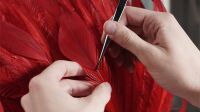
Since December 1999, the revue Féerie has been a nightly fixture, with its 1,000 costumes of feathers, rhinestones, and sequins, and its grand finale of the French cancan. In 2025, the Moulin Rouge lost Janet Pharaoh, its ballet mistress for nearly thirty years, to whom it now dedicates a dance company. Still run by the Clérico family, the Moulin Rouge has its own art workshops—featherwork, shoemaking, and embroidery—and is already preparing for its 140th anniversary.
To learn more, see our articles on the Moulin Rouge's records, its art houses, and the Féerie revue.
The quadrille, ancestor of the French cancan, owes its name to an Englishman: in 1862, Charles Morton renamed it French Cancan, "a funny, noisy dance that comes from France." In 1951, a new venue with Belle Époque décor designed by Henri Mahé opened its doors, ushering in the modern era of the cabaret. Today, ten productions of the musical Moulin Rouge! The Musical, inspired by the Baz Luhrmann film, are touring the world.
1
MOULIN ROUGE
82 boulevard de Clichy, 75018 - Metro: Blanche (Line 2)
Revue every evening at 9:00 PM and 11:30 PM
2
3 Book Now