

Cosmofania Exhibition, thirteen artists at Maubuisson Abbey
MAUBUISSON ABBEY
From October 11, 2026 to February 21, 2027
In an abbey founded by Blanche of Castile, thirteen artists explore what has replaced faith. And it is a natural history museum that opens the exhibition, with crystals. Cosmofania, the third and final installment of a cycle on the sacred, runs from October 11, 2026 to February 21, 2027.
The idea is simple and compelling: the sacred has left the churches, but it has not left people. It has shifted. It now clings to other objects, other gestures, other narratives. This is what the Maubuisson Abbey has been exploring for a year in a triptych of exhibitions, and Cosmofania is its final chapter. The word is coined, from the Greek kosmos, the world, and phainein, to show. To make the world appear.
Crystals to begin with
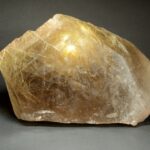
This is the most fitting idea for the exhibition, and it doesn't even originate with an artist. A selection of stones and crystals on loan from the Natural History Museum of the Nantes metropolitan area opens the exhibition. An amethyst geode, a rutilated quartz streaked with gold threads, a cluster of rock crystals. Nothing more than collector's minerals, displayed against a gray background like in a science showcase.
The effect is striking. These objects have been venerated, mounted as amulets, worn as rings, buried with the dead, in all civilizations and for millennia. They are also, quite simply, matter. Five seconds in front of the geode are enough to grasp the exhibition's theme without the need for any explanation.
Thirteen ways to believe, or not
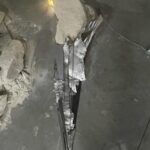
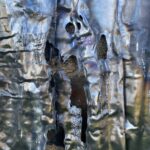
Thirteen artists follow, and the merit of the selection lies in its refusal to choose between irony and acceptance. Philippe Deloison practices automatic mediumistic drawing and dedicates a series to the nuns who inhabited these walls for five centuries: the house is haunted, and he draws what responds. Marion Flament invokes psychostasis, this weighing of souls that Egypt and then Christianity depicted, and creates metallic reliefs that appear to have melted. Ronan Masson pours silver stalactites into the raw concrete, as if the cave were growing through the wall.
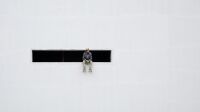
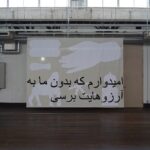
Tal Waldman embroiders Musical and Cosmic Improvisations in minor blue where ultramarine and gold are arranged in rosettes and scales; one thinks of a stained-glass window that has been woven. Darius Dolatyari-Dolatdoust projects a phrase in Persian onto a factory wall, I hope you will realize your dreams without us, and it is a prayer without God. Micha Laury brings out drawings from 1968 to 1973 where the human body is displaced like an object. Charles Fréger, Dany Leriche and Jean-Michel Fickinger, Erik Nussbicker, Régine Cirotteau, Bénédicte Estripeau, Shana Rouaix and Chloé Viton complete the list.
The location does half the work
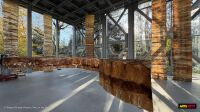
A word must be said about the location, because it plays a significant role. Blanche of Castile, mother of Saint Louis, founded Maubuisson in 1234; the builders worked there from 1236 to 1242 under the direction of Richard de Tour, after whom the avenue is still named. The abbey became the contemporary art center for the Val d'Oise department in 2004, and the bare, high, silent Cistercian halls have never ceased to do what they were built for: to inspire people to look upwards.
The first part of the cycle, Mandorla, looked towards the depths and strata of the Earth's crust. Cosmofania ascends towards the sky. Thirty-five kilometers northwest of Paris, the park is free, as is the parking, and the exhibition costs three euros.
Find our other favorites in our list of the best new exhibitions in Paris.
MAUBUISSON ABBEY
From October 11, 2026 to February 21, 2027
Avenue Richard de Tour, 95310 Saint-Ouen-l'Aumône
Wed. 9:30-11:45 and 13:00-17:45, Thu.-Mon. 13:00-17:45, closed Tue.
Admission: €3 - Reduced rate: €2 - Free for children under 8