
Decryption: the Paris 2024 Olympic Games poster scrutinized
 The countdown is on: only 100 days until the start of the Olympic Games! While waiting for the competition to begin, discover all the symbols hidden behind the official games poster... Ready, set, go!
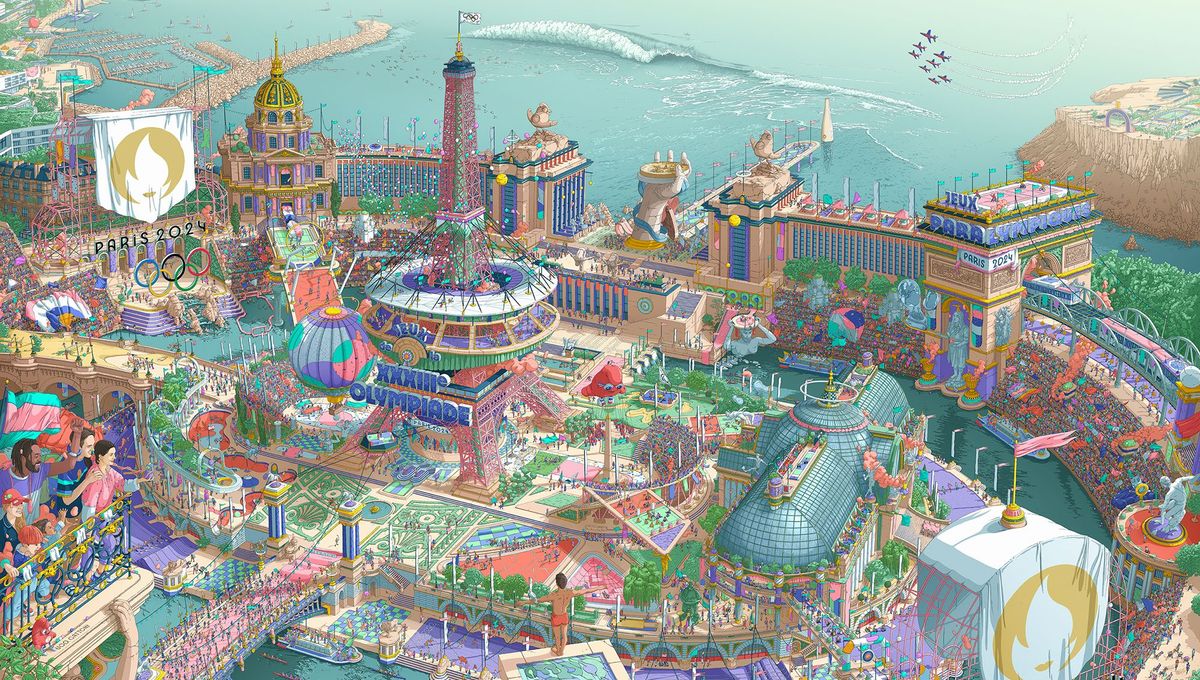
No need to look for good old Charlie. The designer Ugo Gattoni assures us, he did not integrate the tall brunette with glasses into this euphoric landscape of a utopian Paris. Instead, the artist inserted 40,000 characters, men and women, young and old, celebrating the games. A first in the very solemn history of official posters, more widely inclined towards a minimalist, designer or abstract aesthetic, favoring the musculature of the athletes as a showcase of Olympic values in the eyes of the whole world.
Until now, none had dared to show the public in jubilation and put the Olympic and Paralympic Games on an equal footing. It’s now done with this fantastic work, outrageously pop and colorful, teeming with details. The artist imagines Paris as a stadium city open to the world, a gigantic funfair in the shape of a giant arena where gigantism rubs shoulders with the tiny, and where the anecdotal mixes with the great history of sport. Ugo Gattoni took 2000 hours to draw everything, the time has come for us to take a few minutes to look at this record-breaking poster.
The motto of the Olympics
Difficult to see it at first glance... Ugo Gattoni skillfully drowned the Olympic motto in the turquoise waters of the diving board overlooking the city in the foreground: Citius, altius, fortius - Communiter. Understand, “faster, higher, stronger – Together”, the new Olympic maxim since 2021.
Eat, move
In this immense fresco, Ugo Gattoni managed to represent 47 sports, 29 Olympic and 18 Paralympic, including the latest additions such as climbing, breaking or surfing sailing on the Teahupo'o wave of Tahiti . The designer nevertheless allowed himself a few fantasies such as this boxing match at the foot of the Eiffel Tower, this wheelchair tennis meeting at the top of the Arc de Triomphe or this judo fight in motion live on the skytrain.
Game of hide and seek with the Phryges
Can you find the Phryges? The mascots of the Parisian games in the shape of Phrygian caps offer you a little game of hide and seek in the ideal city of Ugo Gattoni. If some are obvious (two have turned into statues, while another floats at the foot of the Eiffel Tower), the last ones are particularly well hidden. A tip: take a look at the balcony, take a walk in the stands to the left of the Stade de France, without forgetting to get off at the next skytrain station.
The Olympic torch… in the water!
Do you have it? Behind the Trocadéro, at the end of the pier, the Olympic torch splashes with its feet in the water, quietly waiting for the return of its precious flame. However, it is not very far away! Invisible to the naked eye, Gattoni hid it aboard the boat Le Belem, the famous three-masted ship which should soon dock in the Marseille marina.
Marianne in close-up
Like an ancient caryatid, Marianne supports the Olympic balcony on her head. This is not the only statue, Gattoni has scattered several dozen. Among them, the extremely famous Discobolus. This is not the first time that the discus thrower has posed, he already appeared on the posters for the 1948 London Olympics.
The birth of the Paralympic Games
What does this mysterious village nestled on the heights of a cliff mean? With this discreet wink, Ugo Gattoni shares with us a piece of history: Stoke Mandeville, an English city considered to be the cradle of the Paralympic movement. Back in 1948. Ludwig Guttman, a neurologist from Stoke Mandeville, encourages his paraplegic or mutilated patients (mainly veterans of the Second World War) to return to sport. The doctor believed in this method and went so far as to organize the first World Wheelchair and Amputee Games on the hospital grounds. Later known as the "Stoke Mandeville Games", this hopeful project eventually won the official ceremony in 1960, the date of the first Paralympic Games.