



At Notre-Dame de la Garde, the earthenware regains its fervor.
At the Notre-Dame de la Garde Museum in Marseille, an exhibition has opened that we may have been waiting for, without realizing it, for three centuries. With Earthenware & Devotion. Marseille–Moustiers in the 17th and 18th Centuries, nearly 150 works, many of them previously unseen, tell the story of the close ties forged in Provence between artistic creation and the expression of faith.
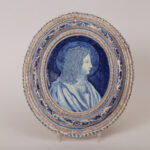
How can one not fall in love with the gentleness of this face? That of Saint John the Evangelist appears on a decorative plaque produced in Marseille, at the Saint-Jean-du-Désert factory, around 1690-1720. Within the oval, a line simultaneously traces the outline of the profile and the curls of hair styled with meticulous care. Around it, the background gives free rein to the imagination of feeling. The subtle shades of blue and manganese resonate against the siliceous material: faith is image, presence, intimacy.
Brought together under the direction of Marina Lafon-Borelli, in partnership with the Academy of Sciences, Letters and Arts of Marseille, these works come from public and private collections. The exhibition accompanies the tercentenary of the Academy of Marseille, founded in 1726.
The exhibition tells a story that long remained on the margins of the grand narratives of the Grand Siècle and its more controversial successor, the 18th century. Historiated plaques, devotional statues, liturgical objects, and ceremonial pieces reveal the golden age of the Marseille and Moustiers potteries.
Initially, between 1679 and 1730, high-fired earthenware reigned supreme. The decorations in shades of blue and manganese draw on biblical scenes, while the heraldic pieces and apothecary jars attest to the prestige of prelates, confraternities, and religious orders.
Then came the plague of 1720. For two years, Marseille was ravaged, and nearly half its population perished. After the catastrophe, the city recovered, and the workshops came back to life. Earthenware was no longer merely used for ceremonial purposes; it became even more so the material support of prayer, entering churches and accompanying daily devotion.
The fate of Joseph Fauchier embodies this shift. Between 1714 and 1725, the potter lost seven of his children. He then joined the Franciscan order. His work, characterized by polychromy and religious statuary, gave rise to Virgins, Christs, and saints of striking power.
And if the earthenware industry declined, it was due to fiscal reasons specific to the political leader then known as Colbert. But make no mistake, earthenware was the height of fashion at the time, and even the King of Portugal ordered a factory... in the Marseille style.
Masterpieces from this era remain, now gathered in this iconic Marseille landmark. You will have to climb the steps of Notre-Dame de la Garde, contemplate the sea from the basilica, and then enter the museum to finally encounter this little-known story. A story of materials and faith, of technique and hardship, of intimacy and brilliance, which was thought to be minor but is revealed here as masterful.
NOTRE-DAME DE LA GARDE MUSEUM
Until November 22, 2026
Daily 9am-5pm