

MaSH 2026: our photos from the night event and the exhibitions to see in the 8th arrondissement
MASH – MATIGNON SAINT-HONORÉ
Late-night event on October 19, 2026
38 galleries. 1 arrondissement. 1 late-night opening. 1 project.
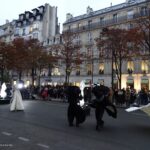
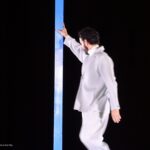
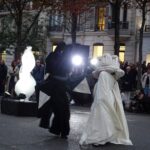
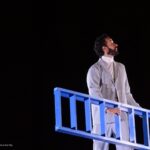
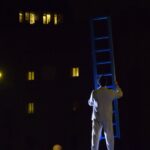
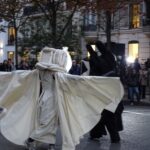
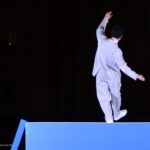
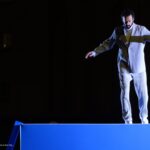
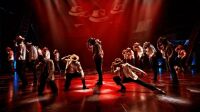
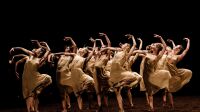
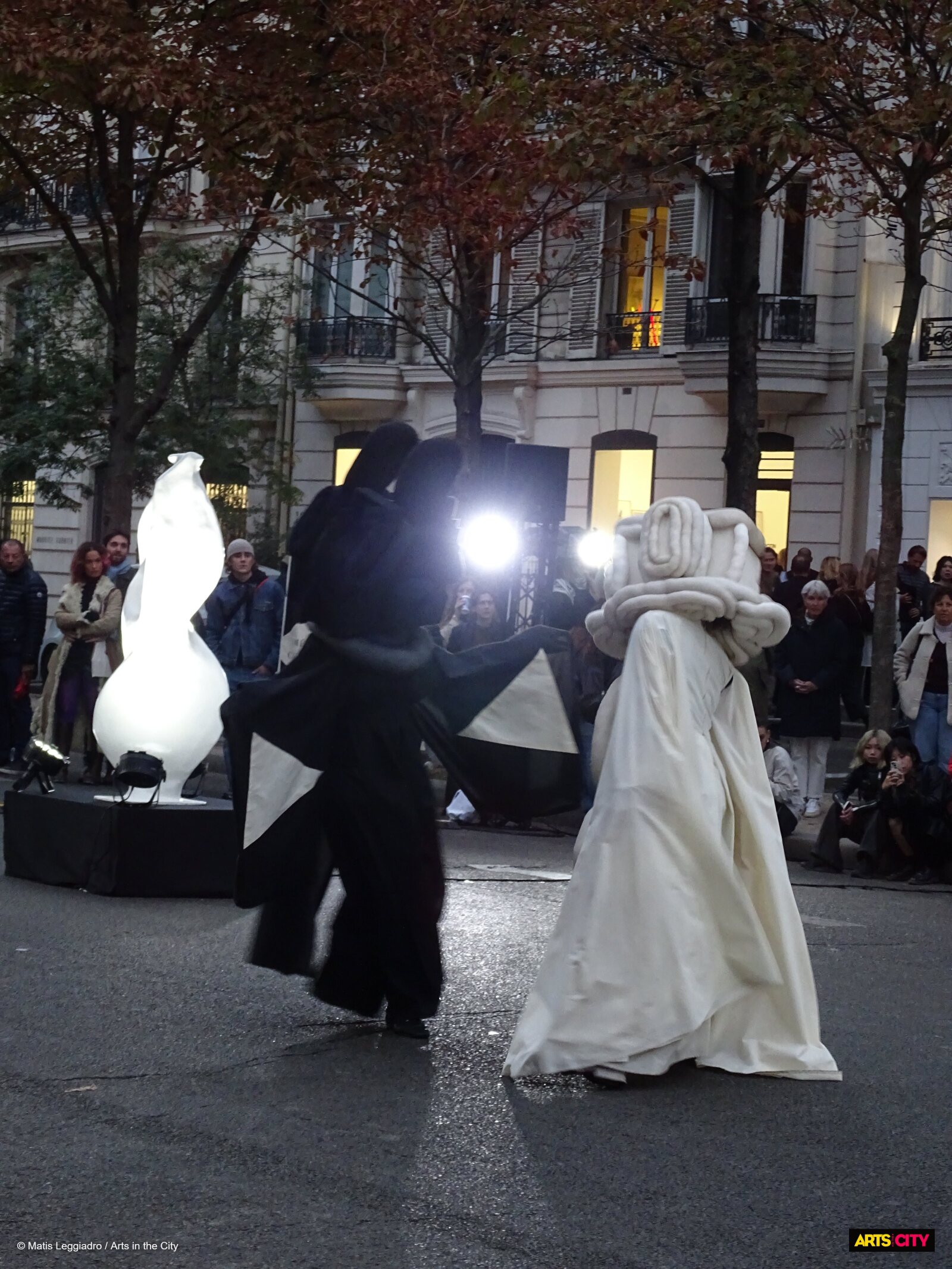
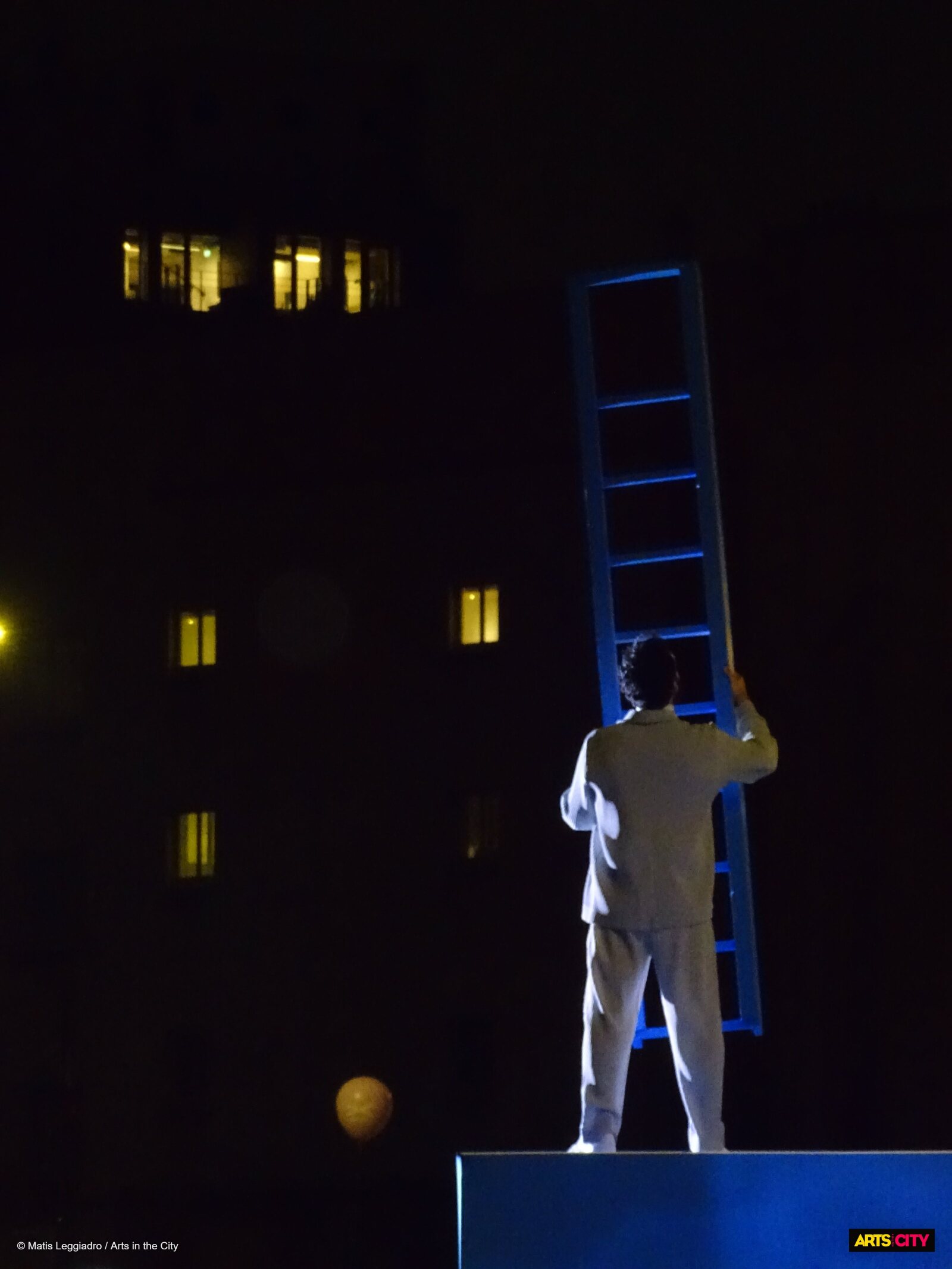
We were at the MaSH late-night opening on Monday, October 19th. As dusk fell, on Avenue Matignon, Amélie Caussade's black and white costumes paraded among the visitors, between sculpted masks and large capes. Later that night, Mathieu Forget, "The Flying Man," performed a balancing act in a white suit on a blue platform and along a ladder, in front of the illuminated facades of the 8th arrondissement.
On Monday evening, October 19th, the third edition of MaSH, the Matignon Saint-Honoré Association's late-night opening, took place, bringing together 38 galleries from the 8th arrondissement to kick off Paris Art Week. This year, it is under the patronage of Jacques Grange, a major figure in interior architecture and decorative arts, who shares a personal selection of favorites, marked by small badges throughout the exhibition. A rich and diverse program, therefore, driven by the idea of welcoming the world for a month, and sometimes two, to see the works of world-renowned artists like Chagall, lesser-known figures like Lee Krasner, and unusual offerings, such as the unprecedented display of Flemish paintings at De Jonckheere. But that's not all, as De Jonckheere is also inaugurating its new space, returning to 65 rue du Faubourg Saint-Honoré. It's a time of metamorphosis, in fact, as several new spaces are being announced: Diane de Polignac at 45 rue de Penthièvre, Galerie Laurentin at 8 rue de Miromesnil, Mennour at 26 avenue Matignon, Mitterrand at 28 avenue Matignon, and Hélène Bailly Marcilhac at 18 avenue Matignon. On the evening of October 19, the neighborhood will be exceptionally pedestrianized and will feature performances by Mathieu Forget and Amélie Caussade.
Our selection of exhibitions to discover during MaSH, from HELENE BAILLY MARCILHAC's new address to New York friendships of the 1980s.
ALL EYES ON YOU
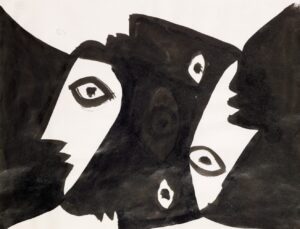
A return to her roots for HELENE BAILLY MARCILHAC. On October 19, the evening of the MaSH late-night opening, the gallery inaugurates a second space at 18 avenue Matignon, the very address where Hélène Bailly Marcilhac's parents established their gallery in the 1980s. Nearly forty years later, the space, completely redesigned and renovated, aims to be more open and experimental than the gallery at 71 rue du Faubourg Saint-Honoré: a simple and adaptable space where modern art can engage in dialogue with design and creation.
For the opening, fashion designer Alexis Mabille conceived and staged All Eyes on You, a journey through portraiture spanning more than a century, from Auguste Rodin to Tom Wesselmann. The subject: the gaze. The artist's gaze upon their model, the model's gaze as they stare at us, flee from us, or surprise us. "In my profession, whether it's haute couture or interior design, everything begins with the gaze," summarizes Alexis Mabille.
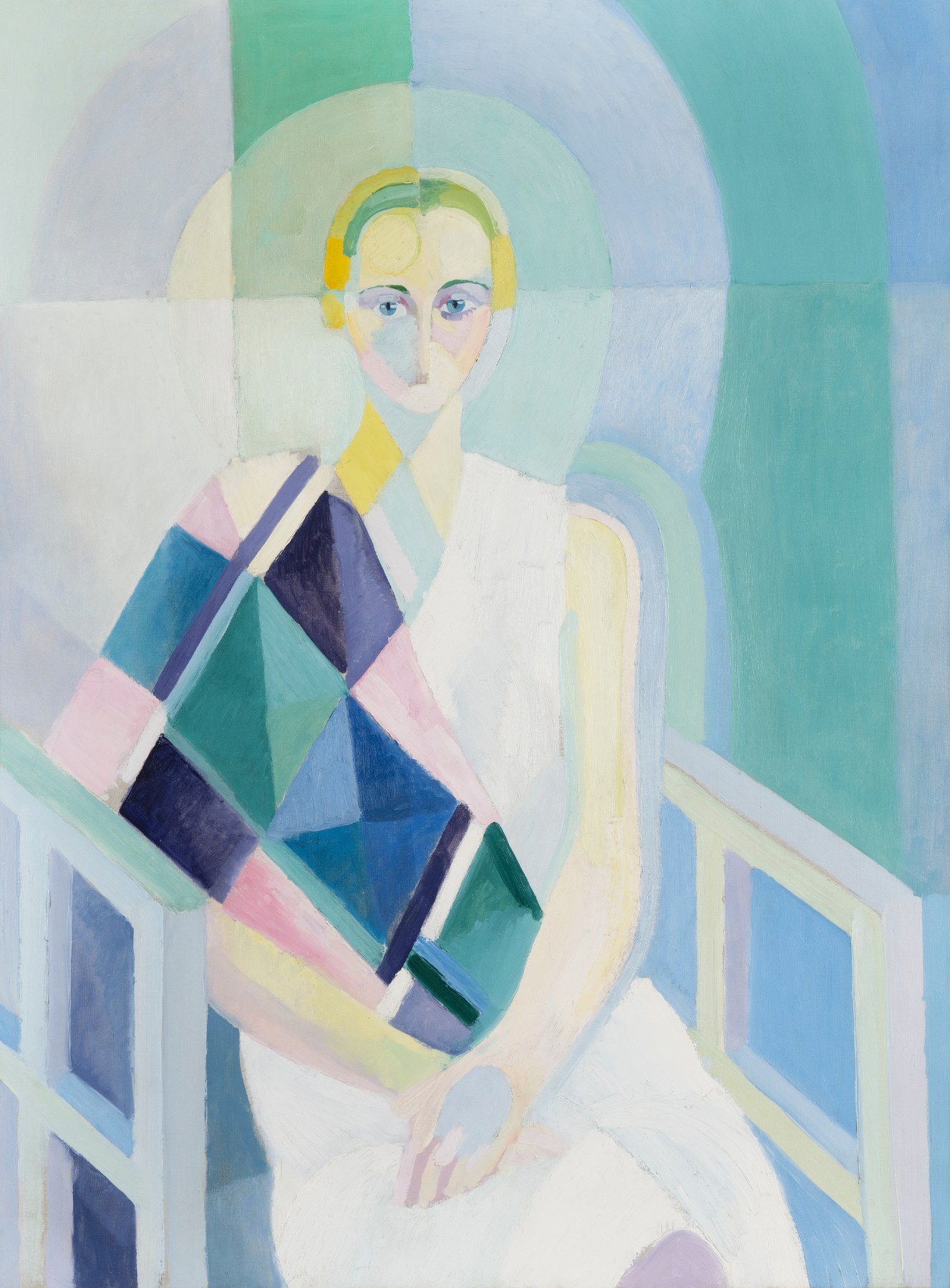
Robert Delaunay, Portrait of Madame Jacques Heim, circa 1926-1927. Courtesy HELENE BAILLY MARCILHAC. Photo © Julien Pépy
From Auguste Chabaud's cabaret scenes to the portraits of Moïse Kisling, Jean Hélion, and Henri Matisse, the human figure becomes a field of observation, both physical and psychological. Two canvases converse at the heart of the exhibition: Robert Delaunay's Portrait of Madame Jacques Heim, painted around 1926-1927, an elegant geometry of pastel tones, and Kees van Dongen's Titine and Toto, dated 1920. Elsewhere, the face emancipates itself to the point of becoming almost autonomous: Auguste Rodin's Mask of Hanako, Alexej von Jawlensky's Meditation, the figures of Alberto Giacometti, the portraits of Francis Picabia. Frontal, absent, internalized, the gaze never reveals everything.
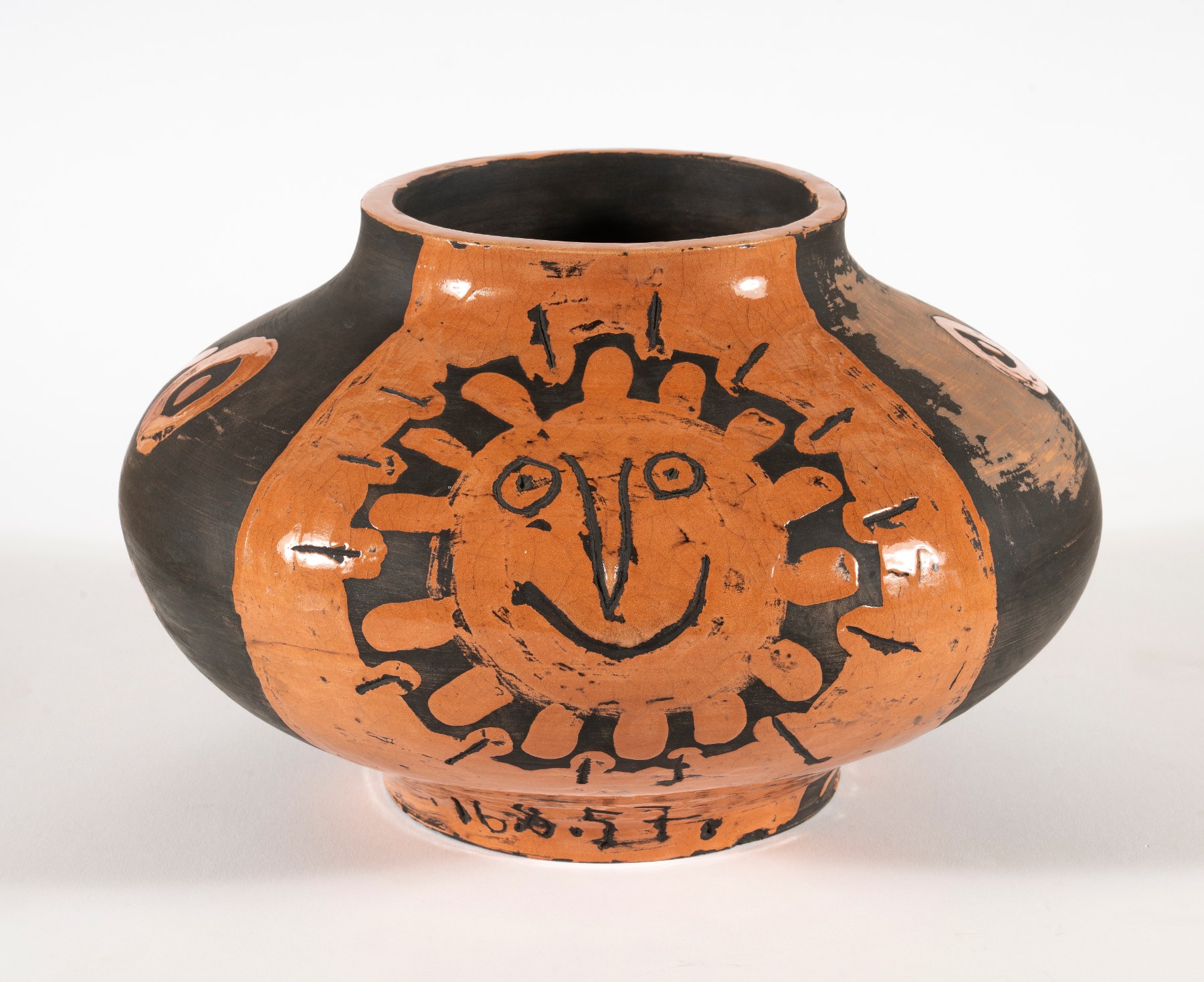
Pablo Picasso, Face and Sun, 1957, painted and glazed ceramic, unique piece. © Succession Picasso 2026. Photo © Julien Pépy 89
The highlight is a collection of Picasso works created between 1902 and 1969. Eyes, noses, and mouths become symbols that the artist moves and reinvents, culminating in the Madoura ceramics where the face leaves the frame to inhabit the object itself. Take, for example, Face and Sun 91, a unique piece dated August 16, 1957: on one side, a smiling sun; on the other, a face with large, round eyes. Simply turning the pot is enough to change its mood.
92
93 Pablo Picasso, Face and Sun 95, 1957, the other side. © Succession Picasso 2026. Photo © Julien Pépy
From resemblance to metamorphosis, All Eyes on You tells a story of the gaze as much as a story of the face. We enter to look at the works; as we move through the exhibition, they are the ones that gaze back at us.
Jacques Grange's favorite: Pablo Picasso, Face with Two Profiles, 1959.
HELENE BAILLY MARCILHAC
From October 20, 2026 to January 9, 2027
Opening on October 19 during the MaSH late-night opening
18 avenue Matignon, 75008 Paris
Metro: Franklin D. Roosevelt (Lines 1/9)
Free admission
PAINTING THE WORLD
How far away should you look at a Flemish painting? From a distance sufficient to grasp the scene, then close enough to discover everything that seemed secondary. A gesture, an object, the way a path crosses the landscape: the detail extends the narrative. For his return to Paris, De Jonckheere brings together paintings from the Southern Netherlands around this attentiveness to the world. Landscapes, portraits, genre scenes, and still lifes offer so many ways of observing an era. The precision of these images makes them immediately familiar. It can also deceive us. An old painting is never a simple record of what was before the artist: it selects, orders, brings together. The everyday rubs shoulders with beliefs; the description of nature can accommodate the imagination. In a society structured by the seasons and religion, representing human activities also means questioning each person's place in the world order. The exhibition thus invites two complementary pleasures: recognizing and searching. Recognizing a movement, an attitude. To seek what eludes us in the construction of the image, its hierarchies and its subtexts. This painting demands time, but it rewards it well: the longer one lingers, the more the scene becomes populated. The exhibition's opening in Loris Azzaro's former salons and studios finally provides this rediscovery with a historical context. The appeal of this event lies in this very tangible encounter with paintings whose virtuosity is also measured by their ability to hold our gaze.
DE JONCKHEERE
From October 19 to November 20, 2026
65 rue du Faubourg Saint-Honoré, 75008 Paris
Metro: Miromesnil (lines 9/13)
Free admission
PEGEEN
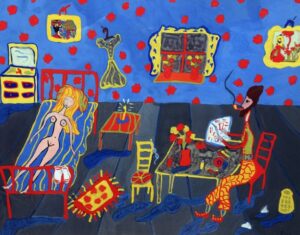
She is Peggy Guggenheim's daughter. But that's not the point. At twelve, she was already exchanging a work with Yves Tanguy. At seventeen, she was included in an exhibition of thirty-one women artists in New York. Pegeen Vail grew up immersed in the avant-garde, exhibiting, working, and creating. This exhibition aims to restore the depth and complexity of her work. Her figures have a doll-like quality: simplified silhouettes, immediately recognizable faces, a presence that is both tender and yet unsettling. The bold colors draw the eye. This apparent simplicity deserves closer attention. Pegeen was familiar with the world of artists and Surrealist explorations; her childlike language developed within this environment, with its own inherent logic. It allowed her to depict intimacy without resorting to the conventions of society portraits or the neatly arranged family scenes. In her work, weddings, motherhood, and scenes of family and everyday life compose a personal chronicle, resembling a miniature theater. A single image can simultaneously encompass happiness as a desire and its impossible attainment. Having died at forty-one, after exhibitions in Europe and the United States, she is now brought into the spotlight.
October 21, from 7:30 p.m. to 8:30 p.m.: Launch of the book dedicated to Pegeen's work, with a talk by Benjamin Hélion.
DURAZZO
From October 19, 2026 to January 4, 2027
23 rue du Cirque, 75008 Paris
Metro: Miromesnil (Lines 9/13)
Mon. to Fri. 11 a.m. to 7 p.m., Sat. 12 p.m. to 6 p.m.
Closed Sun.
Free admission
LEE KRASNER
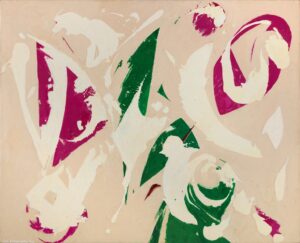
A first solo exhibition in France, more than forty years after his death: this delay speaks volumes about the prominence long accorded to Lee Krasner. Gagosian brings together his paintings and works on paper from the 1960s, a pivotal decade for this figure of American abstraction. It offers an opportunity to closely examine a body of work still too often discussed in relation to his marriage to Jackson Pollock. The choice of a focused period allows for a concentration on the painting itself. In these gestural abstractions, energy plays with bursts of form. Following the relationships between the forms is already a precise experience, engaging the eyes as much as the memory of movement. The juxtaposition of canvases and paper offers another avenue of approach. This is also the value of an exhibition centered on ten years: it allows time to consider the variations, beyond the general image of a style. Organized with Olney Gleason and the Pollock-Krasner Foundation, this presentation accompanies renewed international recognition since the 2019-2021 European retrospective. Above all, it allows for a long-awaited encounter with the works. Before them, the question of Krasner's place in art history becomes very tangible: that of a painter whose choices, rhythms, and inventions demand our full attention.
Jacques Grange's favorite: Lee Krasner, Comet, 1966-1970.
Gagosian Paris
October 19 - December 18 2026
4 rue de Ponthieu, 75008 Paris
Metro: Franklin D. Roosevelt (Lines 1/9)
Tue-Sat 10:30am-6:30pm
Closed Sun & Mon
Free admission
[/compact]
TRIBUTE TO DANIEL CORDIER
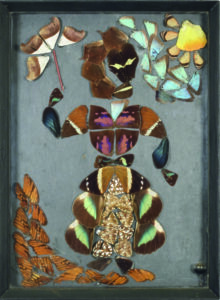
We know him as a member of the Resistance, secretary to Jean Moulin. Less well known is the man who, after the war, dedicated his life to painting, opened a gallery, and championed artists whose works offered little reassurance. By bringing together several of his companions, Laurentin invites us to rediscover Daniel Cordier through his artistic choices. Jean Dewasne, Henri Michaux, Jean Dubuffet, Louise Nevelson, Brassaï, Roberto Matta, Pierre Bettencourt, Bernard Réquichot, and Hans Hartung form a group impossible to categorize as a school. Their names alone suggest very different directions: abstract construction, the invention of signs, the exploration of materials, assemblage, and the deformation of the body or the world. Cordier opened his Parisian gallery in 1956. His commitment continued beyond this activity, notably through his donation to the Centre Pompidou, part of which is housed at Les Abattoirs in Toulouse. Works chosen in the privacy of his judgment become accessible to other perspectives, with the possibility of being discussed, appreciated, or rejected. The exhibition finds its strength in this diversity. It allows us to approach the artists through a relationship of trust and curiosity, rather than through a succession of historical categories. An exhibition of friendships and affinities, in homage to someone who was both a kind of intellectual satellite and a passionate project.
LAURENTIN GALLERY
October 2 to November 7, 2026
8 rue de Miromesnil, 75008 Paris
Metro: Miromesnil (lines 9/13)
Tuesday to Friday 10:30 am - 1 pm and 2 pm - 6:30 pm, Saturday 2 pm - 6:30 pm
Closed Sunday and Monday
Free admission
CHAGALL: THE COLOR OF FEELINGS
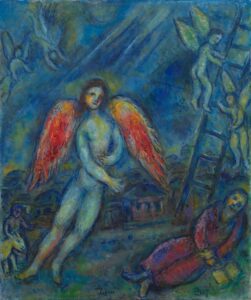
Marc Chagall. Compositions that exist outside of time and place, yet somehow hold together, born of artificial perspectives and blue ideas. The paintings and works on paper, brought together for this exhibition, explore color. Emotion is inscribed within them, through the painter's decisions. A red dominates the surface, a sky resists it. Here, a winged figure struggles to find its place. It would be reductive to categorize meanings as in a dictionary, blue for melancholy, red for love: a color changes its value depending on its surroundings, its extent, its density. Chagall teaches us to recite color. The Bible, which he considered an immense source of poetry, nourished his work for decades. He also illustrated La Fontaine's fables. Generations pondered his canvases, the texts absorbed and passed on anew. This ultra-rich thought ultimately reaches us through color. It is the quest for the marvelous. Chagall pursued his research through numerous techniques, from painting to illustrated books and stained glass. Color encounters a different material, a different light, each time. What can we retain from such work? Perhaps the specter of our lives sometimes passes through here, seeking a height, a horizon, and finding a little bit of ourselves there: in this clear bird, in this stormy sky.
GURR JOHNS
From October 20 to December 8 2026
62 rue La Boétie, 75008 Paris
Metro: Miromesnil (Lines 9 & 13)
Mon-Fri 10am-6pm
Closed Sat & Sun
Free admission
WARHOL, HARING, BASQUIAT: AN ARTISTIC FRIENDSHIP
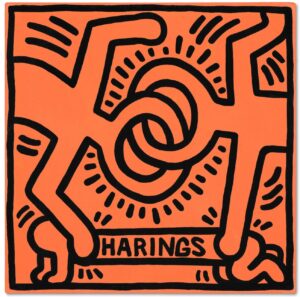
Can a friendship change a painting? In 1980s New York, the exchanges between Andy Warhol, Jean-Michel Basquiat, and Keith Haring touched on ways of working, exhibiting their work, and addressing the public. Opera Gallery revisits these relationships within a city of noise: studios, clubs, subways, and galleries. Three trajectories intersect, without merging. Warhol was already a major figure when Basquiat and Haring emerged. His use of media and commercial images provided them with a crucial precedent. But the relationship was reciprocal. Between 1984 and 1985, Warhol and Basquiat created approximately 160 canvases together. The elder returned to the manual work of the brush; the younger intervened, covering and transforming. The surface then became a site of successive responses, and each had to contend with what the other had just done. Haring developed another form of exchange. His chalk drawings on disused subway advertising panels encountered commuters in their daily lives. With the Pop Shop, opened in 1986 and supported by Warhol, he also sought to disseminate his images beyond the circle of collectors. His friendship with Basquiat was part of this alternative, musical, performative scene, closely linked to drawing. The immediately recognizable sign in Haring, images and words in Basquiat, repetition in Warhol. Their circulation in popular culture raises a question that remains relevant: what becomes of a work when its image is multiplied? A story of friendships and, clearly, social rebellion.
Jacques Grange's favorite: Keith Haring, Untitled, 1984.
OPERA GALLERY
From October 16 to November 18, 2026
62 rue du Faubourg Saint-Honoré, 75008 Paris
Metro: Miromesnil (lines 9/13)
Mon. to Sat. 10am-7pm, Sun. 11am-7pm
Open daily
Free admission
Did you know?
For its third edition, the Nocturne Matignon Saint-Honoré takes place on the evening of Monday, October 19, and opens Paris Art Week. For the second year in a row, it is part of the official program of partner events of Art Basel Paris. Collectors, enthusiasts, and the simply curious can freely move from one gallery to another, and the neighborhood will be exceptionally pedestrianized for the occasion.
Two performances are planned outdoors. At the intersection of Avenue Matignon and Rue du Faubourg Saint-Honoré,Mathieu Forget, nicknamed "The Flying Man," presents a suspended body within the architecture. At the entrance to Avenue Matignon, near Christie's,Amélie Caussade parades costumes and masks among the visitors, in homage to Sophie Taeuber-Arp.
Throughout the exhibition, macarons mark the favorites of Jacques Grange, the patron of this year's event. That evening, the Canadian Cultural Centre also opens its doors for the first time, with guided tours of its exhibition every hour. Among the gallery events, visitors can enjoy a reading by Célia Houdart at Brame & Lorenceau (8 p.m.) and a window display of an animated work by Ian Davenport, in his presence, at Galerie Andres Thalmann.