

Exhibition "Screens Under Constraint: Cinema During the Occupation," at the Jérôme Seydoux-Pathé Foundation
JÉRÔME SEYDOUX-PATHÉ FOUNDATION
From November 27, 2026 to July 10, 2027
From November 27, 2026, to July 10, 2027, the Jérôme Seydoux-Pathé Foundation explores French cinema under the Occupation in "Screens Under Constraint." More than 300 works, excerpts, and documents, spread across two floors, reveal how an industry censored, rationed, and purged of its Jewish talent nevertheless produced dazzling films, from "Les Visiteurs du soir" to "Les Enfants du paradis."



Paris, 1942. The curfew comes early, heating is scarce, ration tickets govern daily life, and yet the theaters are always packed. Between 1940 and 1944, going to the cinema remained one of the few accessible pleasures, and it is from this ordinary act—entering, sitting down, watching—that Screens Under Constraint: Cinema During the Occupation, conceived by Stéphanie Salmon and Célia De Saint Riquier, begins.
What We See There As in those days, the screening begins with the newsreels. On the ground floor, two viewing booths, official instructions, and a cameraman's lens show how information and disinformation were disseminated between Vichy, the occupying forces, the Allies, and the Resistance. Upstairs, the scene becomes more focused: the Film Industry Organization Committee oversees the entire profession, the German company Continental Films produces The Murderer Lives at Number 21 and The Raven under a French facade, double censorship stamps the screenplays, and Jewish artists are excluded from both the sets and the credits.
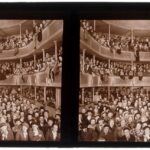
In the studios, film stock is reused, nails from the sets are salvaged, and vouchers are negotiated for costumes. An immersive space presents stereoscopic production photographs by Henri Caruel in 3D, while costume designs, poster sketches, and colorized images tell the story of a wild and stubborn ingenuity. Next come the theaters requisitioned for German soldiers, the Grand Rex and the Marignan leading the way, followed by the films themselves: light comedies, songs by Charles Trenet and Danielle Darrieux, heroines who take control of their destinies, a new generation of filmmakers, from Henri-Georges Clouzot to Robert Bresson.
What remains is what censorship failed to filter. Pontcarral, Colonel of the Empire, whose approved editing is on display, allows hints to slip through that the public perfectly understood, and the journey concludes with Children of Paradise, which was received upon its release as the film of the Liberation. Proof, in short, that an art form can maintain its voice even when silence is imposed upon it.
Discover our other favorites in our list of the top new exhibitions in Paris.
1
Jérôme Seydoux-Pathé Foundation
From November 27, 2026 to July 10, 2027
73 avenue des Gobelins, 75013 Paris - Metro: Place d'Italie (lines 5, 6, 7) or Les Gobelins (line 7)
Tuesday and Friday 2 pm–8:30 pm, Wednesday and Thursday 2 pm–7 pm, Saturday 11:30 am–7 pm
Admission: €5 - Reduced rate: €3 - Combined ticket with a screening: €7
2
3 Learn more