



The Odyssey of Oblivion at the Nantes Museum of Fine Arts
NANTES MUSEUM OF ARTS
From May 22 to August 30, 2026
ODYSSEY OF FORGETTING
Anne and Patrick Poirier
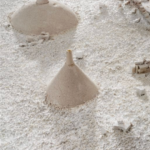
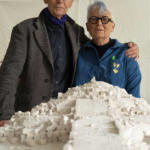
For half a century, Anne and Patrick Poirier have been building what is no more, what never was, what may perhaps be. Cities in ruins untouched by war. Burned-out libraries that no one has read. Tombs that have never held a body. Born at the Villa Medici, in front of the ruins of Ostia Antica, their collaborative work has since woven a parallel memory into the fabric of reality: that of future civilizations, of those that will collapse tomorrow, of those we are destroying right now without realizing it. The Nantes Museum of Fine Arts is dedicating an exhibition to them this summer, bringing the circle full circle.
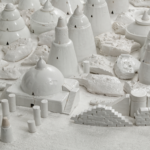
For the Poiriers return here not as guests, but as ghosts: as a child, Patrick lost his father in the bombings that destroyed the city during the Second World War; the body was identified in the museum's courtyard, which had been transformed into a temporary chapel to receive the victims. Eighty years later, it is in this same Patio – a luminous, silent nave surrounded by arcades – that the duo installs The City of Shadows. The work was born from a dream that Anne Poirier had as Russian tanks moved towards Ukraine. In the dream, she descended with their missing son, Alain-Guillaume, towards a white city with dilapidated towers, archetypal volumes, and lifeless triangular openings. The installation that the visitor walks through today is its translation: a symmetrical, brain-shaped plane, inspired by the Etruscan necropolis of Cerveteri, resting on a cloud of feathers. Entry impossible. Inventory of an absence.
Around the exhibition
Around it, other fragments compose the narrative. In the galleries that encircle the Patio, a quote from John Edgar Wideman runs in white neon: “In silence and oblivion, history is a vanished city, razed by war, flood, fire…”. A Above all Ruins of Egypt, a decorative service commissioned in its time by Napoleon from the Sèvres Manufactory and misused by artists into a dismantled utopia, occupies the center of a table. Under the stone vault of thethe Oratory Chapel, plunged into darkness, finally emerge two foundational works of the duo, never seen again in France since their creation: The Fire of the Great Library and the books of Domus Aurea. The voice of Alain-Guillaume Poirier illuminates them from the opposite direction, like a lamp held by an attentive ghost.
Intermittently, a violin pierces the air: Scissura, an unpublished piece composed by Éric Tanguy for the exhibition and performed by Júlia Pusker. The bow does what Patrick does with plaster, what Anne does with thread—it incises the silence so that something may emerge. And then we understand that the Poiriers' work is neither commemoration nor prophecy. It is an instrument. One way, among others, of holding onto the world through its fragility – before it collapses completely.
Did you know?
This is not the first time that the Poirier brothers have exhibited in Nantes . As early as 1985 , the museum exhibited them (Stories of Sculpture ); in 1989 , Domus Aurea already found its place in the Chapel of the Oratory . In 2014, for Le Voyage à Nantes, they orchestrated Curiositas, an off-site exhibition that reached several institutions. Several of their works – Construction n°5 (1982), Mnémosyne (1991-1992), Anima Mundi (2014) – have since entered the collections. Odyssey of Oblivion is therefore not an encounter, it is a return laden with history.
NANTES MUSEUM OF ARTS
From May 22 to August 30, 2026
10 rue Georges Clemenceau, 44000 Nantes